
Introduction: Why the Medical Channel Requires a Different Playbook
Everything covered earlier in this series — category selection, listing optimization, pricing strategy, private labeling — assumes a consumer retail sales model: a customer browses a marketplace listing, evaluates it based on images and reviews, and completes a self-directed purchase. The medical and pharmacy channel operates under a fundamentally different model, where a clinician, pharmacist, or medical retailer often plays a gatekeeping role in the purchase decision, product claims are subject to stricter regulatory scrutiny, and customers frequently expect a level of clinical substantiation that general comfort or sport insoles do not require.
This distinction matters because buyers sometimes assume the medical channel is simply a premium version of consumer retail — a higher price point applied to a similar product with slightly more technical marketing language. In practice, entering this channel successfully requires different regulatory preparation, different supplier capability, and a different go-to-market approach entirely. This guide outlines what that difference looks like in practice.
Section 1: What Distinguishes Medical-Grade From Consumer Insoles
The distinction between medical-grade and consumer insoles goes beyond marketing language, touching design process, regulatory classification, and distribution model.
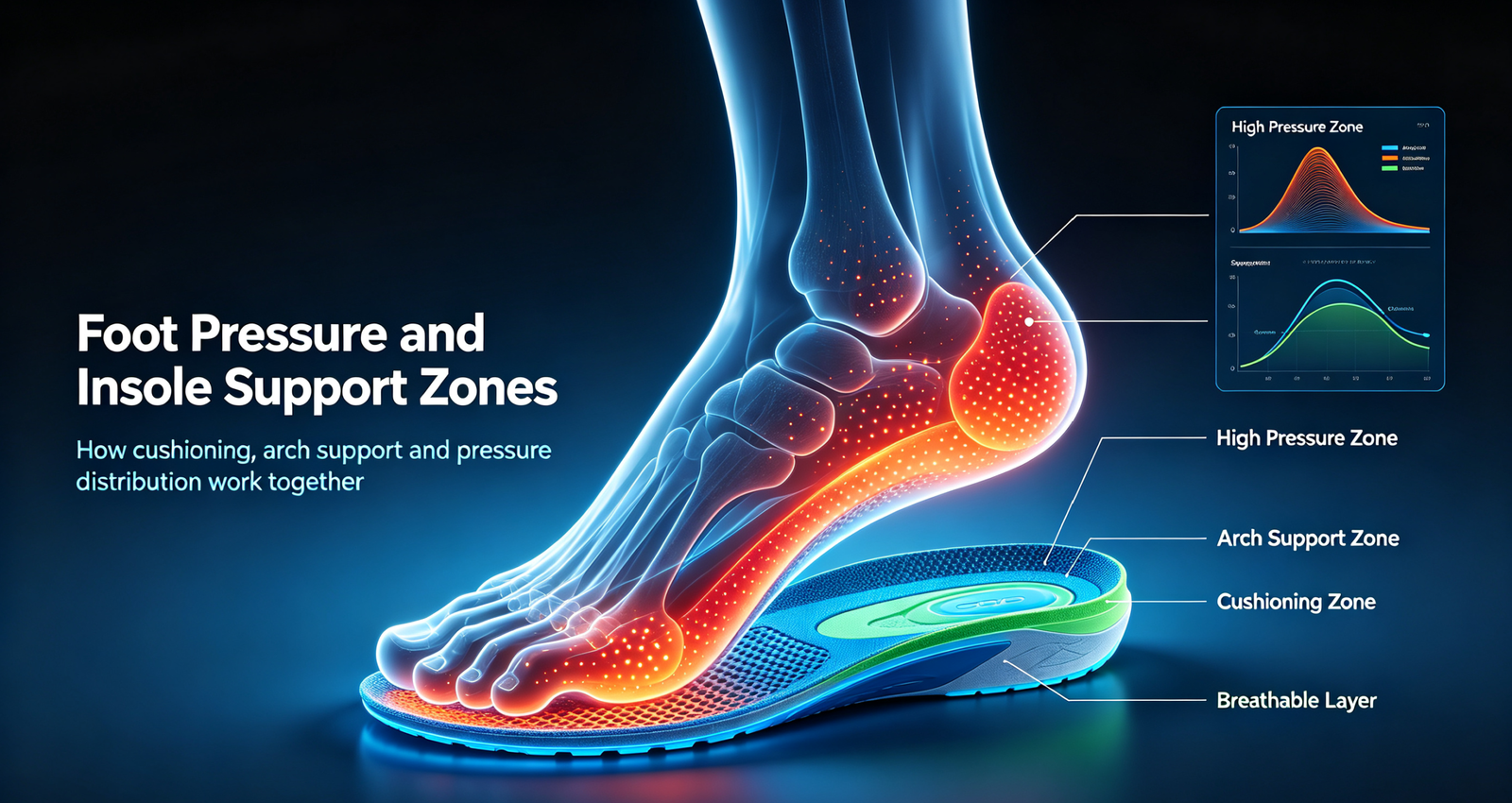
Design and fitting process. Medical-grade orthotic insoles, as discussed in the earlier category-selection guide, are often customized based on individual foot assessment — gait analysis, pressure mapping, or a podiatrist’s clinical evaluation — rather than sold as a standardized, one-size-fits-most product. Diabetic insoles specifically are frequently designed around pressure redistribution principles intended to reduce the risk of diabetic foot ulcers, a clinical objective that requires specific design validation rather than general comfort claims.
Regulatory classification. Depending on the destination market and specific product claims, medical-grade insoles may be classified as medical devices, subjecting them to a materially different regulatory pathway than general consumer comfort products — a classification question buyers should resolve early, since it determines which certifications and registrations are required before the product can legally be marketed and sold.
Distribution model. Medical-grade products typically move through pharmacy, clinical, and medical supply distribution channels rather than general consumer marketplaces, involving relationships with distributors, pharmacy chains, or clinical purchasing groups — a sales process that more closely resembles traditional B2B distribution than direct-to-consumer e-commerce.
Customer decision-maker. In many cases, the purchase decision involves a clinician’s recommendation or prescription rather than a consumer’s independent research and selection — meaning marketing and sales efforts need to address clinical audiences and their evaluation criteria, not just end-consumer purchase psychology.

Section 2: Regulatory Classification — Determining Medical Device Status
One of the first and most consequential decisions buyers face when considering the medical channel is determining whether a specific product will be classified as a medical device in the target market — a classification that depends heavily on the specific claims made about the product rather than the product’s physical construction alone.
General principle. In many regulatory frameworks, an insole marketed with general comfort or cushioning claims may not require medical device classification, while the same physical product marketed with specific therapeutic claims — such as diabetic foot ulcer prevention, correction of a diagnosed condition, or use as part of a prescribed treatment plan — may trigger medical device classification and its associated regulatory pathway.
Market-specific pathways. In the United States, this may involve FDA classification and, depending on the specific risk classification assigned, a registration or clearance pathway. In the European Union, medical device classification may require CE marking under the EU Medical Device Regulation framework, a notably more rigorous pathway than CE marking for general consumer goods. Buyers should confirm the specific regulatory pathway relevant to their target market and intended product claims with qualified regulatory counsel before finalizing product positioning, since misclassification — whether through overly aggressive claims on a general consumer product or inadequate registration for a genuinely medical-grade product — carries significant compliance risk.
Practical guidance: buyers new to this channel should treat regulatory classification as a foundational decision made before finalizing product design or marketing claims, not a documentation step addressed after the product is otherwise ready to launch, since the classification outcome can materially affect product design requirements, required clinical evidence, and go-to-market timeline.
Section 3: Clinical Evidence and Substantiation Requirements
Products marketed with specific clinical claims — diabetic foot ulcer risk reduction, plantar fasciitis relief, pressure redistribution for at-risk patients — generally require a stronger evidentiary basis than the general comfort claims common in consumer retail listings.
Relevant forms of substantiation include pressure-mapping or biomechanical testing data demonstrating the product’s specific pressure redistribution characteristics, clinical study data where the buyer’s supplier or product development partner has conducted or can reference relevant research, and design rationale documentation explaining how the product’s specific construction addresses the clinical objective claimed — consistent with the R&D evaluation criteria discussed in the earlier strategic supplier evaluation guide.
A key sourcing implication: this requirement directly affects supplier selection. As discussed in that earlier guide, suppliers with genuine R&D capability — able to explain design rationale and, ideally, demonstrate collaboration with podiatrists or biomechanical researchers — are considerably better positioned to support a buyer’s medical-channel product line than suppliers who can only reproduce existing designs without underlying clinical or biomechanical justification.
Section 4: Certifications Specific to the Medical Channel
Beyond the general certifications discussed in the earlier strategic supplier evaluation guide (ISO 9001, REACH, RoHS), the medical channel typically requires certifications specific to medical device or clinical-grade manufacturing:
ISO 13485 is the internationally recognized quality management system standard specific to medical device manufacturing, and is generally considered a baseline expectation for any supplier producing genuinely medical-grade insole products — distinct from and more rigorous than general ISO 9001 certification.
Market-specific medical device registrations, such as FDA registration in the United States (where applicable to the product’s risk classification) or CE marking under the EU Medical Device Regulation, as discussed in the prior section.
Biocompatibility testing, particularly relevant for products in direct, prolonged skin contact, confirming that materials used do not pose irritation or allergic response risk — a testing requirement not typically applied to general consumer comfort insoles but often expected in the medical channel.
Buyers should confirm which of these certifications a prospective supplier holds before assuming they can support a medical-channel product line, since many suppliers well-equipped for general consumer insole production have not invested in the additional quality system infrastructure ISO 13485 and related medical certifications require.
Section 5: How Distribution Differs in the Medical and Pharmacy Channel
The go-to-market approach for medical-grade insoles differs substantially from the marketplace-centric distribution model discussed throughout the rest of this series.
Distributor relationships. Medical and pharmacy channel sales frequently rely on relationships with specialized medical supply distributors who maintain existing relationships with pharmacies, clinics, and healthcare providers — a distribution layer that consumer retail sellers typically do not need to navigate, but which requires a different business development approach focused on distributor partnership rather than direct-to-consumer marketing.
Clinical channel sales cycles. Sales cycles in this channel are typically longer than consumer retail, often involving product evaluation by clinical staff, formulary or approved-product-list inclusion processes for larger healthcare systems or pharmacy chains, and relationship-building with clinical decision-makers rather than the rapid, algorithm-driven discovery process characteristic of marketplace retail.
Reimbursement considerations. In some markets, certain medical-grade insoles — particularly diabetic insoles — may be eligible for insurance or healthcare system reimbursement, which can significantly affect purchase decisions but also introduces additional documentation and coding requirements buyers should understand before entering this channel, since reimbursement eligibility often depends on specific regulatory classification and clinical evidence already discussed in this guide.
Section 6: Evaluating Whether This Channel Fits Your Business
Given the higher regulatory barrier and different go-to-market model, buyers should realistically assess several factors before committing resources to the medical channel:
- Regulatory investment capacity. Does the business have the resources — whether internal or through qualified regulatory consultants — to navigate medical device classification and any associated registration process in target markets?
- Supplier capability. Does the buyer have access to, or the ability to develop a relationship with, a supplier holding ISO 13485 certification and genuine clinical-grade R&D capability, as opposed to a general consumer-insole manufacturer?
- Distribution access. Does the business have, or can it realistically build, relationships with medical distributors, pharmacy chains, or clinical purchasing channels — a materially different business development effort than marketplace optimization?
- Timeline tolerance. Is the business prepared for a longer path to revenue in this channel, given longer sales cycles and regulatory preparation time, compared to the relatively fast time-to-market achievable in consumer retail categories covered elsewhere in this series?
Buyers without existing medical or healthcare industry relationships and without appetite for a longer regulatory and sales-cycle timeline may find greater near-term return by focusing on the consumer arch-support category — which, as noted in the original category-selection guide, already captures much of the foot-pain-relief search intent within a lower-barrier consumer retail model — while treating the medical channel as a longer-term expansion opportunity once the core business has scaled.

Conclusion: A Higher-Barrier, Higher-Reward Channel for the Right Buyer
The medical and pharmacy channel offers meaningfully higher price points, stronger customer loyalty, and less price-driven competition than general consumer insole retail — but access requires a fundamentally different preparation process: resolving regulatory classification early, securing a supplier with genuine clinical-grade certification and R&D capability, building the clinical evidence base needed to substantiate therapeutic claims, and developing distribution relationships suited to a clinical rather than marketplace sales model.
Buyers with the resources and patience to navigate this higher barrier are often rewarded with a more defensible, less commoditized market position than the consumer retail segment can offer. Buyers without that capacity are generally better served focusing on the consumer channel strategies covered throughout the rest of this series, revisiting the medical channel as a longer-term expansion opportunity once the core business and supplier relationships have matured.


