

Introduction
For many sports footwear brands, product differentiation has become increasingly difficult.
The global footwear market is highly competitive, and many brands are using similar:
- Upper materials
- Manufacturing technologies
- Design concepts
- Production processes
As a result, brands need new ways to create meaningful differences between product lines.
Functional components have become an important opportunity.
Among footwear components, insoles provide strong potential because they directly influence:
- Comfort perception
- Performance experience
- Product value
However, many brands still manage insoles using a simple approach:
One standard insole → Multiple footwear products
This method may reduce purchasing complexity, but it limits product differentiation.
A professional footwear strategy should consider:
- Entry-level consumers
- Mid-range customers
- Premium performance users
Each segment requires different insole technologies.
By building a multi-tier insole strategy, brands can create a complete product portfolio while improving profitability and consumer satisfaction.
1. Why Sports Footwear Brands Need a Multi-Tier Insole Strategy
A successful footwear portfolio needs to match different consumer expectations.
Not every customer requires the same level of performance.
Different Consumer Needs
Entry-Level Consumers
They usually prioritize:
- Affordable pricing
- Basic comfort
- Lightweight design
They may not need advanced technologies.
Mid-Range Consumers
They expect:
- Better comfort
- Improved support
- More durable materials
They are willing to pay more for noticeable improvements.
Premium Consumers
They prioritize:
- Advanced performance
- Unique technologies
- Professional features
They expect products that provide measurable advantages.
Using the same insole solution across all categories makes it difficult to communicate product differences.
A multi-tier strategy allows brands to clearly define:
- Product value
- Technology level
- Pricing structure
2. Entry-Level Insole Strategy: Focus on Cost Efficiency and Basic Comfort
Entry-level products usually target large-volume markets.
The main objective is:
Provide acceptable comfort while maintaining competitive pricing.
Recommended Materials
Common solutions include:
EVA Foam Insoles
Advantages:
- Lightweight
- Cost-effective
- Easy production
- Flexible customization
Suitable for:
- Casual sneakers
- Basic sports shoes
- Children’s footwear
Standard Foam Insoles
Advantages:
- Simple structure
- Low manufacturing cost
- Easy replacement
Suitable for:
- Mass-market footwear
- Promotional products
Product Features
Entry-level insoles should focus on:
- Basic cushioning
- Lightweight construction
- Breathable surface
- Stable quality
Supplier Requirements
Brands should prioritize suppliers with:
- High production efficiency
- Stable quality control
- Competitive manufacturing costs
At this stage, the focus is not maximum performance.
The focus is:
Reliable quality at the right cost level.
3. Mid-Range Insole Strategy: Improve Comfort and Product Value
The mid-range segment is often the most competitive market area.
Consumers expect clear improvements compared with basic products.
Recommended Materials
Suitable solutions include:
PU Foam Insoles
Benefits:
- Better durability
- Higher resilience
- Longer comfort performance
Memory Foam Insoles
Benefits:
- Pressure distribution
- Softer foot feeling
- Improved comfort experience
Hybrid Foam Structures
Combining:
- EVA
- PU
- Fabric layers
Advantages:
- Balanced performance
- Better cost control
Product Features
Mid-range insoles can include:
- Enhanced cushioning
- Moderate arch support
- Moisture management
- Improved durability
Market Applications
Suitable for:
- Lifestyle sneakers
- Walking shoes
- Training shoes
- Outdoor casual footwear
Strategic Value
Mid-range insoles help brands create stronger product differentiation.
Consumers can clearly feel:
- Better comfort
- Better materials
- Better product quality

4. Premium Insole Strategy: Create Performance Differentiation
Premium sports footwear requires stronger technical differentiation.
Consumers purchasing premium products expect:
- Advanced technology
- Better performance
- Unique experiences
Recommended Technologies
High-Performance PU Foam
Advantages:
- Excellent resilience
- Long-term cushioning
- Premium comfort
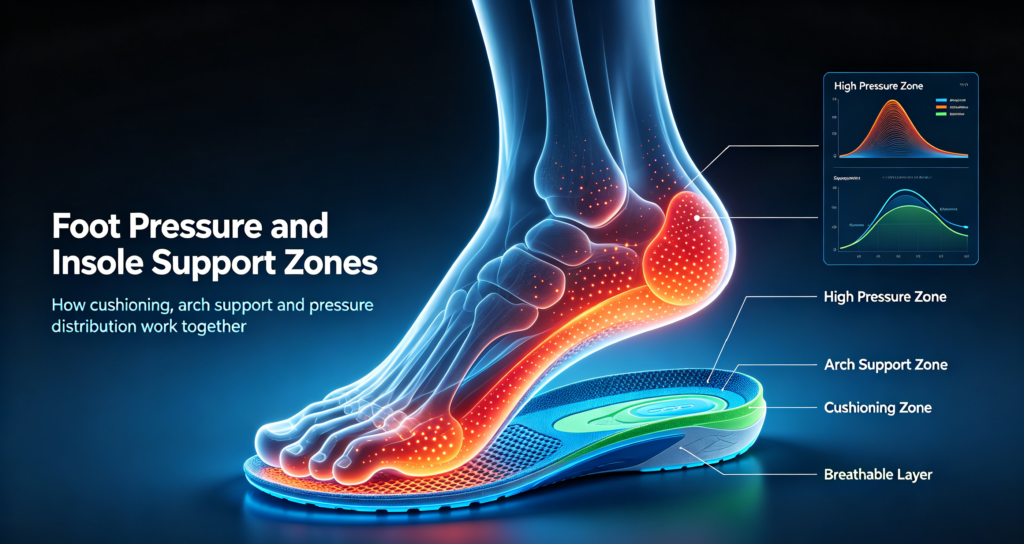
Orthotic Support Structures
Features:
- Arch support
- Heel stabilization
- Pressure control
Suitable for:
- Long-distance sports
- Outdoor activities
- Professional users
Carbon Fiber or TPU Support
Advantages:
- Lightweight reinforcement
- Structural stability
- Performance improvement
Suitable for:
- High-performance footwear
- Professional sports products
Premium Product Positioning
Premium insoles can support:
- Higher selling prices
- Stronger brand image
- Technology storytelling
5. Build Insole Solutions Based on Footwear Categories
A multi-tier strategy should also consider footwear application.
Different shoes require different insole priorities.
Running Shoes
Priority:
- Shock absorption
- Energy return
- Lightweight performance
Recommended:
- High-resilience foam
- Lightweight PU
- Performance structures
Training Shoes
Priority:
- Stability
- Support
- Balance
Recommended:
- Structured foam
- TPU support
Hiking Shoes
Priority:
- Durability
- Moisture management
- Long-term comfort
Recommended:
- High-density PU
- Arch support systems
Walking Shoes
Priority:
- Comfort
- Pressure distribution
Recommended:
- Memory foam
- PU cushioning
Work and Safety Footwear
Priority:
- Fatigue reduction
- Support
- Durability
Recommended:
- High-density foam
- Ergonomic support designs

6. Use Insole Technology to Create Product Differentiation
A strong insole strategy is not only about materials.
It is also about creating unique product concepts.
Comfort-Focused Products
Possible positioning:
“All-day comfort footwear”
Technology:
- Memory foam
- Pressure relief structures
- Soft cushioning
Performance-Focused Products
Possible positioning:
“Enhanced athletic performance”
Technology:
- Energy return foam
- Lightweight structures
- Support systems
Health-Oriented Products
Possible positioning:
“Foot support and fatigue reduction”
Technology:
- Orthotic structures
- Arch support
- Ergonomic designs
Functional positioning helps consumers understand product value.
7. How Brands Should Work With Insole Suppliers
Developing a successful product strategy requires supplier cooperation.
Step 1: Share Product Positioning
Brands should communicate:
- Target consumers
- Price level
- Performance goals
Step 2: Select Appropriate Materials
Suppliers can recommend:
- Material combinations
- Structure options
- Manufacturing solutions
Step 3: Prototype and Testing
Evaluate:
- Comfort
- Durability
- Performance
- User feedback
Step 4: Continuous Improvement
Improve products based on:
- Market feedback
- Consumer reviews
- Sales performance
A strong supplier can become a valuable product development partner.
8. Common Mistakes Brands Make When Developing Insole Strategies
Mistake 1: Using One Insole for All Products
Problem:
Different products have different performance requirements.
Mistake 2: Choosing Technology Without Market Positioning
Problem:
Expensive materials do not always create customer value.
Mistake 3: Ignoring Supplier Development Capability
Problem:
Weak suppliers limit innovation opportunities.
Mistake 4: Focusing Only on Material Cost
Problem:
Low-cost solutions may increase quality risks.
9. Future Trends in Insole Product Strategies
The future of footwear insoles will focus on:
Sustainable Solutions
Including:
- Recycled foam
- Bio-based materials
- Environmentally friendly fabrics
Personalized Comfort
Including:
- Foot scanning
- Customized support
- Individualized structures
Smart Footwear Integration
Including:
- Pressure sensing
- Temperature management
- Data monitoring
Functional Combination
Future products may combine:
- Cushioning
- Support
- Sustainability
- Smart technology
Practical Checklist for Building an Insole Product Portfolio
Product Planning
□ Define target market segments
□ Create different product tiers
□ Match technology with customer needs
Material Selection
□ Evaluate performance requirements
□ Balance cost and value
□ Develop suitable material combinations
Supplier Management
□ Select technically capable suppliers
□ Develop long-term cooperation
□ Conduct regular product improvement
Market Strategy
□ Create clear product differentiation
□ Communicate functional benefits
□ Monitor consumer feedback
Conclusion
For sports footwear brands, insoles are no longer just standard components.
They are strategic tools for:
- Product differentiation
- Consumer experience improvement
- Market segmentation
- Brand value enhancement
A successful multi-tier insole strategy allows brands to serve different customers while maintaining clear product positioning.
By combining the right materials, technologies, and supplier partnerships, sports footwear brands can create stronger product portfolios and achieve better competitiveness in the global market.
The future winners in footwear will not only design better shoes.
They will design better performance systems inside every shoe.


