

Introduction
Foot fatigue has become an increasingly common concern among modern consumers.
From office workers standing for long periods to outdoor enthusiasts, athletes, and industrial workers, millions of people experience discomfort caused by continuous pressure on their feet.
Common symptoms include:
- Tired feet after daily activities
- Heel discomfort
- Arch pressure
- Foot soreness
- Reduced walking comfort
Many people believe that replacing shoes is the only solution.
However, the insole inside the footwear often plays an equally important role.
The insole is the component directly connected with the foot. It helps manage:
- Pressure distribution
- Shock absorption
- Foot stability
- Wearing comfort
A well-designed insole does not simply make footwear softer.
It works by improving the interaction between the foot and the shoe.
Professional footwear brands increasingly focus on functional insoles because consumers are demanding products that provide:
- Better comfort
- Longer wearing experience
- Foot health benefits
For footwear manufacturers and brands, understanding the relationship between insole design and foot fatigue is essential for developing products that meet modern market expectations.
1. Why Do Feet Become Fatigued?
To understand how insoles reduce fatigue, it is important to understand why foot fatigue occurs.
The human foot contains:
- 26 bones
- 30+ joints
- More than 100 muscles, tendons, and ligaments
The foot is designed to support body weight while adapting to different movements.
However, modern lifestyles often create excessive stress on the feet.
Long Periods of Standing
People who stand for many hours may experience increased foot pressure.
Common groups include:
- Factory workers
- Retail employees
- Healthcare workers
- Hospitality staff
Continuous standing can cause:
- Heel pressure
- Arch discomfort
- Reduced circulation
- Muscle fatigue
Long-Distance Walking
Walking involves repeated impact with every step.
During daily walking, the foot continuously absorbs:
- Body weight
- Ground reaction forces
- Repetitive impact
Without proper cushioning and support, fatigue can accumulate over time.
High-Impact Activities
Sports activities create higher mechanical stress.
Examples:
- Running
- Hiking
- Training exercises
Athletes often require footwear components that provide:
- Shock absorption
- Stability
- Energy management
Poor Foot Support
Another major cause of foot fatigue is insufficient support.
When footwear does not provide proper support, the foot may experience:
- Excessive movement
- Uneven pressure distribution
- Increased muscle effort
This is where functional insoles become important.
2. How Insoles Help Reduce Foot Fatigue
A high-quality insole helps reduce fatigue through several key functions:
- Cushioning impact
- Supporting foot structure
- Improving pressure distribution
- Enhancing footwear comfort
Cushioning: Reducing Impact on the Feet
One of the most important functions of an insole is cushioning.
Every step creates impact between the foot and the ground.
Without sufficient cushioning, this force transfers directly through:
- Heel
- Arch
- Joints
A cushioning insole helps absorb part of this impact.
How Cushioning Materials Work
Different materials absorb impact in different ways.
Common insole materials include:
EVA Foam
EVA is widely used because it provides:
- Lightweight cushioning
- Flexibility
- Shock absorption
Common applications:
- Sports footwear
- Casual shoes
PU Foam
PU provides:
- Long-lasting resilience
- Better durability
- Stable cushioning
Common applications:
- Work footwear
- Comfort shoes
Memory Foam
Memory foam adapts to foot shape.
Benefits:
- Pressure reduction
- Personalized comfort feeling
Common applications:
- Lifestyle footwear
- Comfort products
A professional manufacturer selects materials based on the intended application rather than using one material for every product.
3. Pressure Distribution: Why It Matters for Comfort
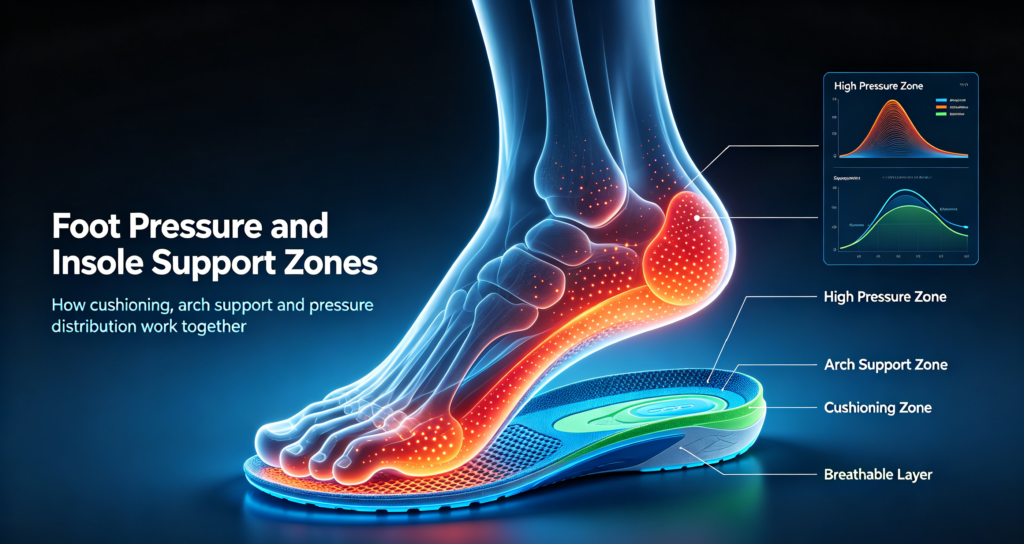
Another important function of insoles is improving pressure distribution.
The bottom of the foot does not experience equal pressure everywhere.
Certain areas naturally carry more load, including:
- Heel area
- Forefoot area
- Metatarsal region
Poor pressure distribution may lead to discomfort.
How Insoles Manage Pressure
A properly designed insole can redistribute pressure by using:
- Different material densities
- Support structures
- Cushioning zones
For example:
Heel Cushioning Zone
Designed to absorb impact during:
- Walking
- Running
- Landing movements
Arch Support Area
Designed to improve:
- Foot stability
- Weight distribution
Forefoot Cushioning Area
Designed to reduce pressure during:
- Standing
- Walking
Why Footwear Brands Focus on Pressure Management
Consumers increasingly expect footwear products to provide more than basic protection.
Modern footwear development focuses on:
- Comfort engineering
- Biomechanical support
- Long-term wearing experience
Functional insoles have become an important product differentiation strategy.
4. Arch Support and Foot Stability
Arch support is one of the most discussed features in functional insoles.
The foot arch plays an important role in:
- Shock absorption
- Weight transfer
- Walking stability
What Happens Without Proper Support?
Insufficient support may cause:
- Uneven pressure distribution
- Increased foot strain
- Reduced comfort during long-term activity
How Arch Support Insoles Work
Arch support structures help:
- Improve foot alignment
- Reduce excessive movement
- Provide additional stability
However, effective arch support is not about making the structure as hard as possible.
The ideal design should balance:
- Support
- Comfort
- Natural foot movement
Different Users Need Different Support Levels
Footwear brands need to consider different user groups.
Examples:
Daily Comfort Users
May prefer:
- Moderate support
- Soft cushioning
Outdoor Users
May require:
- Stronger stability
- Durable structures
Work Footwear Users
May require:
- Long-term support
- Pressure reduction
Professional insole development focuses on matching product design with user needs.
5. Different Types of Insoles for Reducing Foot Fatigue
Not all insoles are designed for the same purpose.
Different users have different foot conditions, activities, and footwear requirements.
A professional insole design considers:
- User lifestyle
- Footwear application
- Activity intensity
- Comfort expectations
For footwear brands, understanding these differences is important when developing product lines.
A successful insole product strategy usually includes different solutions for different market segments.
Comfort Insoles
Comfort insoles are designed for consumers who prioritize everyday wearing experience.
Typical users include:
- Office workers
- Daily walkers
- Casual footwear users
The main goals are:
- Soft cushioning
- Reduced pressure feeling
- Improved overall comfort
Common Material Structure
Comfort insoles often use:
- EVA foam
- Memory foam
- PU foam
These materials help create a softer foot-contact experience.
Product Design Considerations
A comfort insole usually focuses on:
- Moderate cushioning
- Smooth surface feeling
- Lightweight construction
The design goal is not maximum support, but better comfort during daily activities.
Sports Performance Insoles
Sports activities create higher mechanical stress compared with normal walking.
Sports insoles are designed to support:
- Repeated impact
- Dynamic movement
- Foot stability
Key Performance Requirements
Sports footwear brands usually focus on:
Shock Absorption
Reducing impact during:
- Running
- Jumping
- Training
Energy Return
Helping improve:
- Foot response
- Movement efficiency
Stability
Supporting the foot during:
- Direction changes
- High-intensity activities
Common Material Solutions
Sports insoles may combine:
- EVA foam
- TPU support structures
- Carbon fiber reinforcement
to achieve different performance levels.
Work and Safety Shoe Insoles
Workers who stand or walk for long periods have different requirements.
Typical industries include:
- Manufacturing
- Construction
- Logistics
- Healthcare
Main Challenges
Long working hours can create:
- Heel pressure
- Foot fatigue
- Lower limb discomfort
Functional Requirements
Work shoe insoles often require:
- Long-term cushioning
- Durable materials
- Strong support
Recommended Material Solutions
Common combinations include:
- High-density PU foam
- Durable EVA
- Reinforced support structures
These solutions help maintain performance during extended use.
Outdoor and Hiking Insoles
Outdoor activities require footwear components that can handle changing environments.
Users may face:
- Uneven terrain
- Long walking distances
- Heavy footwear loads
Key Requirements
Outdoor insoles need:
- Stability
- Shock absorption
- Durability
- Moisture management
Structural Design Features
Common features include:
- Reinforced heel areas
- Arch support structures
- Multi-layer cushioning systems
6. How Different Insole Materials Affect Comfort
The material selection of an insole directly affects the user’s wearing experience.
There is no single “best” insole material.
The right material depends on:
- Product application
- Target consumers
- Performance requirements
EVA Insoles: Lightweight and Versatile Comfort
EVA is one of the most commonly used materials in footwear.
Its advantages include:
- Lightweight
- Flexible
- Cost-effective
- Good cushioning
Best Applications
EVA is commonly used for:
- Sports shoes
- Casual footwear
- Children’s footwear
Comfort Characteristics
EVA provides:
- Soft cushioning
- Easy movement
- Lightweight wearing experience
For brands targeting mass-market footwear, EVA remains an effective solution.
PU Insoles: Durable Comfort for Long-Term Use
PU foam provides a different comfort experience compared with EVA.
Its advantages include:
- High resilience
- Long-lasting cushioning
- Better compression resistance
Best Applications
PU is commonly used in:
- Work shoes
- Safety footwear
- Premium comfort footwear
Comfort Characteristics
PU provides:
- Stable cushioning
- Better durability
- Long-term support
For users who spend many hours on their feet, PU can provide consistent comfort over time.
Memory Foam Insoles: Adaptive Comfort
Memory foam is known for its ability to adapt to foot shape.
Main Benefits
Memory foam can provide:
- Pressure reduction
- Personalized feeling
- Soft contact experience
Best Applications
Commonly used in:
- Lifestyle footwear
- Comfort shoes
- Walking shoes
Carbon Fiber Insoles: Structural Support Performance
Carbon fiber represents a more advanced functional solution.
Unlike foam materials that mainly provide cushioning, carbon fiber focuses on:
- Reinforcement
- Stability
- Structural support
Best Applications
Commonly used in:
- Performance footwear
- Outdoor products
- Premium footwear
Multi-Material Combination: The Future of Functional Insoles
Modern insole development increasingly uses combined structures.
Examples:
EVA + PU
Combines:
- EVA lightweight cushioning
- PU durability
EVA + TPU
Provides:
- Cushioning
- Additional support
EVA + Carbon Fiber
Provides:
- Lightweight construction
- Structural reinforcement
Professional manufacturers use different materials together to achieve a balanced product.

7. Why Insole Structure Is as Important as Material
Many people focus only on materials when choosing insoles.
However, material alone does not determine performance.
The structure of the insole is equally important.
A professional insole combines:
- Material selection
- Thickness design
- Support structure
- Pressure distribution
Thickness Design
Thickness affects:
- Cushioning ability
- Shoe fitting
- Comfort feeling
Too thick:
- May reduce shoe space
Too thin:
- May provide insufficient cushioning
Heel Cup Design
The heel area absorbs significant impact.
A deeper heel structure can help:
- Improve stability
- Keep the foot positioned correctly
Arch Structure
The arch area requires careful design.
The goal is:
- Provide support
- Maintain natural movement
Surface Material Design
The surface layer affects:
- Breathability
- Moisture control
- Foot contact feeling
Common surface materials include:
- Mesh fabric
- Microfiber
- Antibacterial textiles
For footwear brands, successful insole development requires balancing all these elements.
A good insole is not simply soft.
It is a carefully engineered footwear component.
8. How Professional Insole Manufacturers Develop Comfort Solutions
For footwear brands, creating a comfortable insole is not simply choosing a soft material.
A successful insole product requires a combination of:
- Foot biomechanics understanding
- Material technology
- Structural design
- Manufacturing experience
Professional manufacturers analyze the relationship between:
- Foot movement
- Pressure distribution
- Footwear construction
- User expectations
before developing a final solution.
Understanding Target Users Before Development
Different users experience foot fatigue for different reasons.
Therefore, manufacturers need to understand the target market first.
Office and Daily Wear Users
Main concerns:
- Long periods of standing
- Walking fatigue
- General discomfort
Recommended solutions:
- Soft cushioning materials
- Lightweight structures
- Comfortable surface fabrics
Athletes and Outdoor Users
Main concerns:
- Repetitive impact
- Foot stability
- Performance support
Recommended solutions:
- Shock absorption structures
- Reinforced support areas
- High resilience materials
Industrial Workers
Main concerns:
- Long working hours
- Hard surfaces
- Continuous foot pressure
Recommended solutions:
- Durable cushioning materials
- Stable support structures
- Long-lasting comfort performance
A professional supplier does not start with a product.
They start with understanding:
“Who will use this insole and what problem should it solve?”
9. S-King Functional Insole Solutions for Different Applications
As footwear markets become more competitive, brands need more than standard components.
They need footwear solutions that create product differentiation.
S-King develops customized insole solutions based on different footwear applications.
Comfort Insole Solutions
For brands targeting everyday comfort markets, S-King focuses on:
- Cushioning performance
- Lightweight construction
- Comfortable foot contact
Possible material structures include:
- EVA foam
- Memory foam
- PU foam
Typical applications:
- Casual shoes
- Walking shoes
- Lifestyle footwear
The goal is to help brands create footwear products that provide better daily wearing experiences.
Sports Insole Solutions
Sports consumers increasingly expect footwear to provide both performance and comfort.
S-King develops sports-oriented solutions focusing on:
- Shock absorption
- Energy response
- Foot stability
Possible structures include:
- EVA cushioning layers
- TPU reinforcement
- Carbon fiber support components
Applications:
- Running shoes
- Training footwear
- Outdoor sports shoes
Work and Safety Footwear Solutions
For professional footwear markets, comfort must remain stable during long-term use.
S-King focuses on:
- Durability
- Pressure reduction
- Structural support
Possible solutions include:
- High-density PU foam
- Reinforced EVA structures
- Supportive footbed designs
Applications:
- Safety shoes
- Work boots
- Industrial footwear
Premium Functional Insole Solutions
For brands targeting higher-value markets, advanced materials can create stronger differentiation.
Examples include:
- Carbon fiber support structures
- Multi-layer cushioning systems
- Advanced composite materials
These solutions help brands move beyond basic comfort products.

10. OEM and ODM Process for Custom Insoles
For international footwear brands, customization capability is becoming increasingly important.
A reliable insole supplier should support customers throughout the entire development process.
Step 1: Product Requirement Analysis
The first step is understanding:
- Target customers
- Footwear category
- Performance requirements
- Price positioning
For example:
A running shoe brand may prioritize:
- Lightweight performance
A work boot brand may prioritize:
- Durability and support
Step 2: Material Recommendation
Based on requirements, manufacturers recommend suitable materials.
Options may include:
- EVA
- PU foam
- Memory foam
- Carbon fiber
- TPU
Step 3: Structure Development
Engineers design:
- Thickness distribution
- Support zones
- Cushioning areas
The purpose is to create a product that balances:
- Comfort
- Functionality
- Manufacturing feasibility
Step 4: Prototype Production
Before mass production, samples are developed for evaluation.
Customers can review:
- Product appearance
- Footwear fitting
- Comfort experience
- Structural performance
Step 5: Testing and Optimization
Based on feedback, manufacturers adjust:
- Material combination
- Hardness
- Structure
- Production parameters
Step 6: Mass Production
After approval, the product enters production.
Professional suppliers maintain:
- Production standards
- Quality inspection procedures
- Packaging requirements
to ensure consistent delivery.

11. Building a Complete Insole Product Line for Footwear Brands
For brands entering the footwear market, offering only one insole product may limit market opportunities.
A stronger strategy is creating a complete product portfolio.
Entry-Level Comfort Series
Target:
Mass-market consumers
Features:
- Cost-effective materials
- Basic cushioning
- Daily comfort
Possible materials:
- EVA foam
- Basic fabric surface
Performance Series
Target:
Sports and active users
Features:
- Improved cushioning
- Better stability
- Enhanced support
Possible materials:
- EVA
- TPU
- Composite structures
Professional Series
Target:
Work and specialized footwear
Features:
- Long-term durability
- Pressure management
- Functional support
Possible materials:
- PU foam
- High-density EVA
- Reinforcement structures
Premium Series
Target:
High-value customers
Features:
- Advanced materials
- Functional design
- Premium positioning
Possible materials:
- Carbon fiber
- Multi-layer composites
- Advanced foam systems
For distributors and footwear brands, this product segmentation strategy helps:
- Cover different customer groups
- Increase product value
- Reduce price competition
12. Future Trends in Foot Health and Insole Development
As consumers become more aware of foot health, insoles are evolving from simple comfort accessories into functional footwear components.
In the past, many consumers viewed insoles as replaceable items.
Today, footwear brands increasingly recognize insoles as an important part of product innovation.
Future insole development will focus on:
- Advanced materials
- Sustainable solutions
- Personalized comfort
- Functional performance
Sustainable Insole Materials
Sustainability has become a major focus across the global footwear industry.
Brands are looking for ways to reduce environmental impact while maintaining product performance.
Future insole materials may include:
- Recycled foam materials
- Bio-based materials
- Environmentally friendly manufacturing processes
Recycled EVA Solutions
Traditional EVA remains one of the most widely used footwear materials.
However, recycled EVA solutions are becoming increasingly important.
Potential benefits include:
- Reduced material waste
- Lower environmental impact
- Improved sustainability image
For footwear brands targeting environmentally conscious consumers, sustainable insole options can become an important product advantage.
Bio-Based Foam Development
Bio-based materials are gaining attention because they use renewable resources.
Future development may include:
- Plant-based materials
- Renewable polymers
- Lower-carbon manufacturing solutions
For suppliers, sustainability is not only a material choice.
It also requires:
- Supply chain management
- Manufacturing optimization
- Quality consistency
13. Smart Technology and Personalized Insoles
Another important direction in foot health is personalization.
Every person’s foot structure is different.
Factors such as:
- Foot shape
- Weight distribution
- Walking habits
- Activity level
can influence comfort requirements.
Digital Foot Analysis
With the development of digital technology, brands can use:
- Foot scanning
- Pressure mapping
- Data analysis
to better understand individual needs.
This creates opportunities for more personalized footwear solutions.
Functional Structure Customization
Future insoles may become more targeted through customized designs.
Examples include:
Personalized Arch Support
Different users may require different levels of support.
Customized Cushioning Zones
Different areas of the foot may need different cushioning levels.
Data-Based Product Development
Footwear brands can use consumer data to develop:
- Better fitting products
- More comfortable designs
- Specialized footwear solutions
Although fully personalized insoles are still developing, the trend shows that footwear is moving from general comfort toward more precise solutions.
14. Why Functional Insoles Are Becoming More Important for Footwear Brands
The footwear market is becoming increasingly competitive.
Simply improving appearance is no longer enough.
Consumers are paying more attention to:
- Comfort
- Health benefits
- Wearing experience
This creates new opportunities for footwear brands to differentiate through functional components.
Improving Product Value
A basic shoe and a comfort-engineered shoe may have very different market positioning.
A functional insole can help brands communicate:
- Better comfort
- Better support
- Better user experience
Creating Product Differentiation
Many footwear products compete in similar categories.
Adding functional insole technology can help brands create unique selling points.
Examples:
- Running shoes with enhanced cushioning
- Work boots with fatigue reduction features
- Outdoor shoes with improved stability
Increasing Customer Satisfaction
Comfort directly influences:
- Repeat purchases
- Brand reputation
- Customer reviews
A well-designed insole can improve the overall footwear experience.
For this reason, more footwear companies are treating insoles as a key product development component rather than a simple accessory.
15. How S-King Helps Brands Develop Better Insole Solutions
Developing a successful insole product requires cooperation between:
- Material suppliers
- Engineers
- Footwear designers
- Manufacturing teams
S-King provides customized footwear component solutions to help brands develop functional and market-ready insole products.
Material Expertise
S-King supports different material solutions, including:
- EVA foam
- PU foam
- Memory foam
- Carbon fiber structures
- Composite materials
Based on customer requirements, suitable materials can be selected for:
- Comfort
- Performance
- Durability
- Cost control
Product Development Support
From concept to production, S-King supports:
- Structure design
- Material selection
- Sample development
- Production optimization
Manufacturing Consistency
For international customers, stable production quality is essential.
S-King focuses on:
- Process control
- Quality inspection
- Production consistency
to support long-term cooperation with global footwear brands.
OEM and ODM Partnership
Whether customers already have a product design or need assistance developing a new solution, S-King supports flexible cooperation models.
Services include:
- Custom insole development
- Private label solutions
- Material customization
- Bulk production
Conclusion
Foot fatigue is not caused by a single factor.
It is influenced by:
- Foot structure
- Activity level
- Footwear design
- Cushioning performance
- Support characteristics
A well-designed insole helps manage these factors by improving:
- Impact absorption
- Pressure distribution
- Foot stability
- Overall comfort
For footwear brands, insoles represent more than a comfort accessory.
They are an opportunity to create differentiated products, improve customer experience, and build stronger market competitiveness.
From EVA cushioning solutions to PU comfort systems, carbon fiber support structures, and customized functional designs, professional insole manufacturers help brands transform foot health concepts into reliable footwear products.
By combining material knowledge, engineering capability, and manufacturing experience, S-King supports global partners in developing high-quality insole solutions for different footwear applications.


