

Introduction
Foot comfort and support have become increasingly important factors in modern footwear development.
Consumers are not only looking for attractive designs but also expecting footwear that provides:
- Better support
- Improved comfort
- Reduced foot pressure
- Enhanced wearing experience
This demand has increased interest in custom orthotic insoles across multiple footwear markets.
Unlike standard flat insoles, orthotic insoles are designed with specific support structures to address different foot requirements.
They are commonly used in:
- Comfort footwear
- Work shoes
- Sports footwear
- Medical and functional footwear
For global footwear brands, developing custom orthotic insoles requires a combination of:
- Ergonomic design
- Material selection
- Manufacturing expertise
- Quality control
A professional OEM insole manufacturer can help brands create customized solutions that meet different market requirements.
1. What Are Custom Orthotic Insoles?
Custom orthotic insoles are specially designed footwear inserts that provide targeted support based on foot structure and movement requirements.
Unlike standard comfort insoles, orthotic designs focus on:
- Foot alignment
- Pressure control
- Stability improvement
- Support optimization
A custom orthotic insole may include:
- Contoured arch support
- Deep heel cup
- Reinforced support areas
- Multi-density materials
These features help create a more controlled and supportive footwear experience.
For brands, orthotic insoles offer opportunities to develop specialized footwear products for different customer groups.
2. Why Are Orthotic Insoles Important for Footwear Brands?
The demand for supportive footwear continues to grow because consumers are paying more attention to long-term comfort.
Poor footwear support may contribute to:
- Uneven pressure distribution
- Foot discomfort
- Reduced wearing comfort
- Increased fatigue during daily activities
By integrating orthotic insole technology, footwear brands can improve product value and differentiation.
Benefits include:
- Enhanced customer experience
- Premium product positioning
- Expanded target markets
3. Key Features of Custom Orthotic Insoles
3.1 Anatomical Arch Support
The foot arch plays an important role in:
- Weight distribution
- Movement stability
- Shock absorption
Orthotic insoles use specially designed arch structures to provide targeted support.
Common designs include:
- Low arch support
- Medium arch support
- High arch support
This allows brands to develop products for different user needs.
3.2 Deep Heel Cup Design
The heel area absorbs significant impact during standing and walking.
A deep heel cup helps:
- Stabilize the heel
- Improve foot positioning
- Reduce unnecessary movement
This feature is commonly used in:
- Walking insoles
- Work footwear
- Sports support insoles
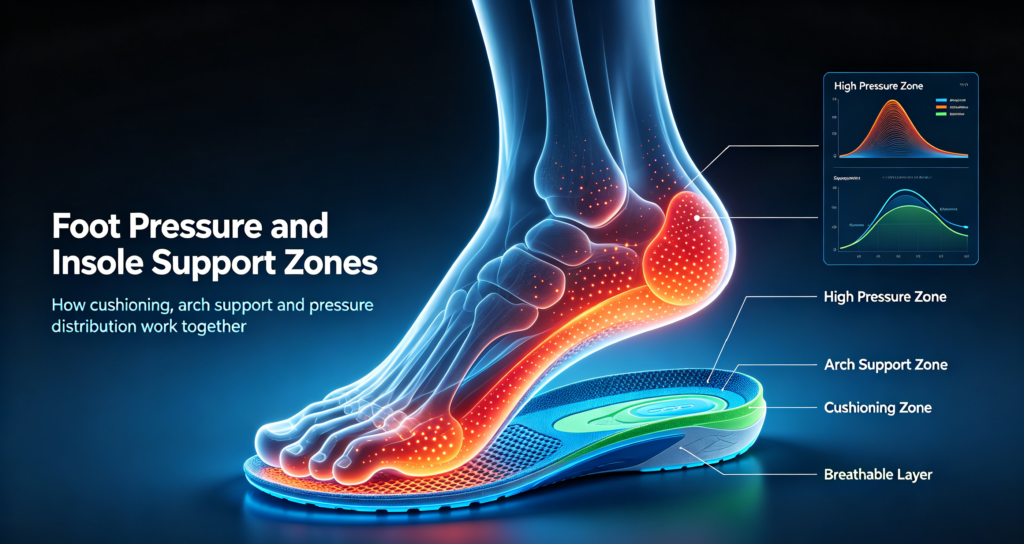
3.3 Pressure Distribution System
Custom orthotic insoles are designed to distribute pressure more evenly.
Common support areas include:
- Heel
- Arch
- Forefoot
This helps improve overall comfort during extended use.
3.4 Multi-Layer Construction
Professional orthotic insoles often combine multiple materials.
Examples:
- EVA cushioning layer
- PU comfort layer
- TPU support structure
- Fabric top cover
This creates a balance between:
- Support
- Cushioning
- Durability
4. Materials Used in Custom Orthotic Insoles
Material selection directly affects product performance.
EVA Foam
EVA is widely used in orthotic insoles because of:
- Lightweight cushioning
- Flexible processing
- Adjustable density
Applications:
- Comfort footwear
- Sports insoles
- Everyday orthotic products
PU Foam
PU provides:
- Long-lasting cushioning
- Better resilience
- Premium comfort
Applications:
- High-end support footwear
- Professional comfort products
Memory Foam
Memory foam offers:
- Pressure adaptation
- Soft cushioning
- Personalized comfort
Applications:
- Lifestyle footwear
- Comfort-focused orthotic products
TPU Support Components
TPU reinforcement provides:
- Structural support
- Better stability
- Shape retention
Applications:
- Functional footwear
- Performance support insoles
5. Custom Orthotic Insoles Applications
Orthotic insoles are used across multiple footwear industries.
Comfort Footwear
Brands use orthotic insoles to develop:
- Walking shoes
- Everyday comfort footwear
- Lifestyle products
Key requirements:
- Cushioning
- Support
- Long-lasting comfort
Work and Safety Footwear
Workers who stand for long hours require:
- Stability
- Pressure relief
- Durable support
Applications:
- Safety boots
- Industrial footwear
- Service shoes
Sports Footwear
Athletes require:
- Foot stability
- Impact management
- Movement control
Applications:
- Running shoes
- Training shoes
- Outdoor footwear
Footcare and Orthopedic Products
Orthotic products are designed for users seeking:
- Additional support
- Comfort improvement
- Functional footwear solutions
6. OEM Manufacturing Process for Custom Orthotic Insoles
For global footwear brands, selecting an experienced manufacturing partner is essential.
Product Design Development
OEM manufacturers help brands with:
- Product requirements analysis
- Structure design
- Material recommendation
- Prototype creation
Sample Development
Before mass production, manufacturers provide:
- Prototype samples
- Design adjustment
- Performance evaluation
Mass Production
Manufacturing processes include:
- Material cutting
- Layer bonding
- Shaping
- Surface finishing
- Quality inspection
Quality Control
Professional inspection covers:
- Product dimensions
- Material consistency
- Bonding quality
- Appearance standards
Reliable production ensures consistent quality for international customers.

7. How Global Brands Customize Orthotic Insoles
Different brands have different market positioning and customer requirements.
Customization options include:
Material Selection
Brands can choose:
- EVA density
- Foam hardness
- Support materials
- Surface fabrics
Structural Design
Customization includes:
- Arch support height
- Heel cup depth
- Cushioning zones
- Reinforcement structures
Branding Options
OEM services may include:
- Logo printing
- Custom packaging
- Private label production
This allows brands to create unique products for their target markets.

8. Why Choose S-King as Your Custom Orthotic Insoles Manufacturer?
S-King specializes in customized insole manufacturing for global footwear brands, distributors, and OEM buyers.
S-King develops solutions for:
- Orthotic insoles
- Comfort insoles
- Sports insoles
- Functional footwear products
Professional OEM & ODM Capability
S-King supports:
- Product design
- Material selection
- Prototype development
- Custom molds
- Mass production
Flexible Material Solutions
S-King works with:
- EVA foam
- PU foam
- Memory foam
- Carbon fiber
- TPU support materials
to create customized orthotic solutions.
Reliable Manufacturing Support
S-King provides:
- Quality control
- Production management
- Packaging solutions
- Global B2B support
For brands searching for a reliable custom orthotic insole supplier, S-King offers complete support from concept development to finished products.
Conclusion
Custom orthotic insoles help footwear brands create products with improved support, comfort, and market differentiation.
Through ergonomic design, advanced materials, and customized manufacturing, brands can develop footwear solutions for different user groups and applications.
For global footwear companies, choosing an experienced OEM insole manufacturer is essential for achieving consistent quality and reliable product performance.
With professional development capabilities and flexible customization options, S-King helps brands create high-quality orthotic insole solutions for international markets.


