

Introduction: Why Product Selection Matters for Supermarket Buyers
For supermarket buyers, the challenge of managing an insole category is not simply choosing products with the highest technical performance.
The real challenge is finding products that achieve a balance between:
- Consumer demand
- Sales volume
- Profitability
- Inventory efficiency
- Market positioning
A supermarket customer usually does not visit the store specifically to purchase professional footcare products.
Instead, they often purchase insoles because they want:
- More comfortable shoes
- Less foot fatigue during daily activities
- Better cushioning
- Seasonal protection
- Improved wearing experience
Therefore, supermarket buyers should prioritize products that are:
- Easy to understand
- Suitable for broad customer groups
- Simple to purchase
- Reliable in quality
A successful retail insole category usually includes several product groups instead of relying on a single type of product.
1. Everyday Comfort Insoles: The Core Volume Category
Among all insole categories, everyday comfort insoles usually represent the largest sales opportunity for supermarkets.
The reason is simple:
Almost every consumer can become a potential buyer.
Whether customers wear:
- Sneakers
- Casual shoes
- Work shoes
- Walking shoes
they may look for additional comfort.
Why Everyday Comfort Insoles Sell Well
These products usually offer:
- Affordable pricing
- Wide application
- Easy purchasing decisions
Most consumers understand the benefit immediately:
“Make my shoes more comfortable.”
Common Materials
EVA Insoles
EVA is one of the most widely used materials in retail insoles.
Advantages:
- Lightweight
- Flexible
- Cost-effective
- Good cushioning performance
Suitable for:
- Mass-market products
- Daily comfort applications
- Promotional products
Soft Foam Composite Insoles
Combining different foam layers can improve:
- Cushioning
- Comfort feeling
- Product value perception
These structures are often suitable for mid-range retail products.
Recommended Retail Positioning
Everyday comfort insoles are usually suitable as:
- Entry-level products
- High-volume products
- Customer acquisition products
For supermarkets, these products should usually occupy the largest proportion of shelf space.
2. Memory Foam Insoles: Premium Comfort for Daily Users
Memory foam insoles have become popular in retail channels because they provide a different comfort experience compared with traditional foam insoles.
They are often associated with:
- Softness
- Pressure distribution
- Premium comfort
Target Consumers
Memory foam insoles are suitable for:
- Office workers
- Consumers who stand for long periods
- Older customers
- Daily walking users
Retail Advantages
Compared with basic EVA insoles, memory foam products usually have:
- Higher perceived value
- Higher selling price
- Stronger product differentiation
This makes them suitable as a mid-range category.
Product Features Buyers Should Consider
When selecting memory foam insoles, retailers should evaluate:
- Foam recovery performance
- Thickness
- Breathability
- Surface fabric quality
Poor-quality memory foam may lose comfort quickly after repeated use.

3. PU Insoles: Long-Term Comfort and Durability
PU (Polyurethane) insoles are commonly used in products where durability and long-term comfort are important.
Compared with some lightweight foam materials, PU can provide:
- Better resilience
- Longer service life
- Stable cushioning performance
Suitable Applications
PU insoles are suitable for:
- Work shoes
- Casual footwear
- Premium comfort products
Why Retailers Should Consider PU Insoles
For supermarket buyers, PU products can help create a higher-value product segment.
They are suitable for consumers who are willing to pay more for:
- Better durability
- Better wearing experience
- Longer product lifespan
4. Sports and Shock Absorption Insoles
With increasing participation in:
- Walking
- Running
- Fitness activities
- Outdoor sports
sports-related insoles have become an important retail category.
Main Consumer Needs
Sports consumers usually focus on:
- Impact reduction
- Cushioning
- Stability
- Lightweight performance
Common Product Features
Retail sports insoles may include:
- Gel cushioning areas
- EVA shock absorption layers
- Reinforced support structures
Target Retail Channels
Suitable for:
- Supermarkets with sports sections
- Outdoor retail areas
- General merchandise stores
Sports insoles should not completely replace everyday comfort products.
Instead, they should complement the category by attracting active consumers.
5. Odor Control and Breathable Insoles
Foot odor management is another common consumer demand.
Especially in:
- Warm climates
- Long working hours
- Closed footwear environments
many consumers look for products with:
- Breathability
- Moisture control
- Odor reduction features
Common Materials and Technologies
Examples include:
- Activated carbon layers
- Breathable mesh fabrics
- Moisture-absorbing materials
- Antimicrobial treatments
Retail Advantages
These products have clear consumer communication:
“Keep shoes fresh.”
Because the benefit is easy to understand, they often perform well in mass retail environments.
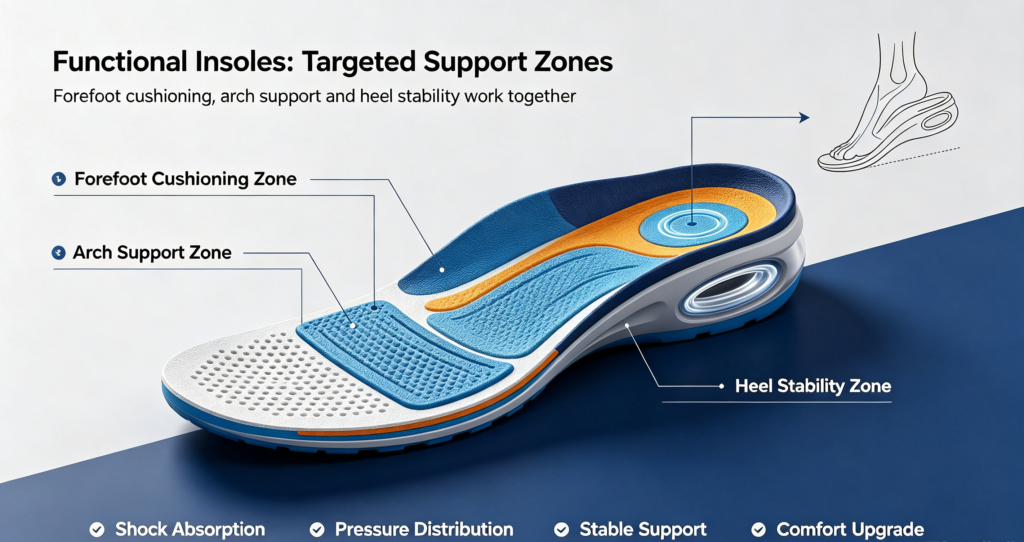
6. Arch Support and Functional Support Insoles
Functional support insoles represent a more specialized category.
Compared with general comfort products, they target consumers looking for:
- Additional support
- Better foot stability
- Improved wearing comfort
Target Customers
Examples:
- Long-distance walkers
- Workers standing for extended periods
- Consumers seeking additional support
Retail Positioning
These products should usually be positioned as:
- Mid-to-high-end products
- Functional upgrade options
They should not replace basic comfort products because the consumer group is narrower.
7. Thermal and Seasonal Insoles
Seasonal products provide additional opportunities for supermarkets, especially in regions with cold winters.
Winter Insole Categories
Common products include:
- Wool insoles
- Fleece-lined insoles
- Thermal reflective insoles
Retail Strategy
Seasonal insoles should be planned according to:
- Local climate
- Consumer habits
- Sales season
For example:
Cold regions should prepare inventory before winter demand increases.
8. Recommended Product Portfolio for Supermarket Buyers
A balanced supermarket insole category may include:
| Category | Recommended Share | Main Purpose |
| Everyday Comfort Insoles | 40%-50% | Main sales volume |
| Memory Foam / PU Insoles | 20%-30% | Improve profit margin |
| Sports & Cushioning Insoles | 10%-15% | Expand usage scenarios |
| Odor Control Insoles | 10% | Meet specific needs |
| Functional Support Insoles | 5%-10% | Premium positioning |
| Seasonal Insoles | Adjust by market | Seasonal sales |
This structure helps supermarkets achieve:
- High sales turnover
- Reasonable margins
- Broader customer coverage
- Lower inventory risk
9. How Suppliers Help Retailers Select the Right Products
A professional insole supplier should not only provide products.
They should help retailers understand:
- Market demand
- Product positioning
- Material selection
- Sales potential
For example, based on a retailer’s market:
A supplier may recommend:
For General Supermarkets
Focus on:
- EVA comfort
- Memory foam
- Odor control
For Premium Retail Channels
Increase:
- PU products
- Carbon fiber solutions
- Advanced support designs
For Cold Climate Markets
Increase:
- Thermal products
- Wool insoles
This type of cooperation helps retailers build more effective product categories.
10. Building a Competitive Insole Category with S-King
S-King supports retail partners with a wide range of insole solutions designed for different market requirements.
Our capabilities include:
- EVA comfort insoles
- PU foam insoles
- Memory foam insoles
- Carbon fiber insoles
- Functional support designs
- Seasonal footwear comfort solutions
Through material expertise and manufacturing experience, S-King helps retailers create product portfolios that balance:
- Consumer demand
- Product performance
- Cost efficiency
- Market positioning
11. How Retailers Can Improve Insole Sales Through Better Product Positioning
For supermarket buyers, selecting the right insole products is only the beginning.
A common challenge in retail channels is that many insole products fail to achieve expected sales performance, not because the product quality is poor, but because the product positioning does not match customer expectations.
Consumers often do not understand the technical differences between:
- EVA insoles
- Memory foam insoles
- PU insoles
- Gel insoles
- Support insoles
Therefore, retailers need to create a clear product positioning strategy that helps customers quickly identify the right product.
A successful insole category should answer:
Who is this product for?
What problem does it solve?
Why is it worth purchasing?
11.1 Position Products According to Customer Needs
Many supermarkets organize products only by material type.
For example:
- EVA section
- PU section
- Gel section
However, this approach is often difficult for ordinary consumers.
Most customers do not purchase based on material knowledge.
They purchase based on their needs.
A better merchandising strategy is to organize products by application scenarios.
Comfort Solutions
Target customers:
- Daily footwear users
- Office workers
- Casual shoe users
Recommended products:
- EVA comfort insoles
- Memory foam insoles
- Soft cushioning insoles
Key message:
“Improve everyday comfort.”
Work Comfort Solutions
Target customers:
- Factory workers
- Retail employees
- Healthcare workers
- People standing for long hours
Recommended products:
- PU insoles
- High-density cushioning insoles
- Shock absorption designs
Key message:
“Reduce foot fatigue during long working hours.”
Active Lifestyle Solutions
Target customers:
- Walkers
- Runners
- Outdoor enthusiasts
Recommended products:
- Sports insoles
- Gel cushioning insoles
- Lightweight performance insoles
Key message:
“Support active movement.”
Seasonal Comfort Solutions
Target customers:
- Cold climate consumers
Recommended products:
- Wool insoles
- Thermal insoles
- Fleece-lined insoles
Key message:
“Keep feet warm and comfortable.”
11.2 Create Clear Product Tiers
Another effective strategy is establishing different product levels.
A supermarket should avoid having too many products with similar prices and similar functions.
A clear tier structure helps customers compare products.
Entry Level: Basic Comfort
Purpose:
Generate high sales volume.
Features:
- Affordable price
- Simple function
- Wide customer coverage
Examples:
- EVA foam insoles
- Basic fabric insoles
Mid Level: Enhanced Comfort
Purpose:
Become the main profit category.
Features:
- Better materials
- Improved comfort
- Higher perceived value
Examples:
- Memory foam insoles
- PU cushioning insoles
Premium Level: Functional Performance
Purpose:
Improve category value.
Features:
- Advanced structures
- Specialized functions
- Premium materials
Examples:
- Carbon fiber insoles
- Advanced support insoles
A well-designed product ladder allows retailers to serve different customer groups without relying only on price competition.
11.3 Avoid Overloading Shelves With Similar Products
One common mistake in supermarket purchasing is selecting too many similar products.
For example:
A retailer may stock:
- Five EVA insoles
- Six memory foam insoles
- Several similar cushioning products
However, customers may become confused because the differences are unclear.
A better strategy is:
Differentiate Products by Function
Instead of:
Product A:
EVA insole
Product B:
Another EVA insole
Create:
Product A:
Daily comfort
Product B:
Long-standing support
Product C:
Sports cushioning
Differentiate Products by Price
For each category, maintain:
- Good value option
- Mainstream option
- Premium option
Differentiate Products by Consumer Group
Examples:
- General consumers
- Workers
- Sports users
- Seniors
This approach improves shelf efficiency and reduces unnecessary inventory.
12. How Supermarkets Can Reduce Inventory Risks When Buying Insoles
Inventory management is one of the most important challenges for retail buyers.
Unlike some fast-moving consumer goods, insoles have many variations:
- Sizes
- Materials
- Functions
- Seasonal demand
Poor inventory planning can lead to:
- Slow-moving stock
- Excess inventory
- Reduced shelf efficiency
12.1 Start With Core Products
New retailers entering the insole category should avoid launching too many SKUs immediately.
A practical approach is starting with core products:
High-volume products
Examples:
- EVA comfort insoles
- Memory foam insoles
- Breathable insoles
These products usually have broad market acceptance.
Supporting products
Examples:
- Odor control insoles
- Sports insoles
These expand customer coverage.
Premium products
Examples:
- Carbon fiber insoles
- Advanced support designs
These improve category value.
After analyzing sales data, retailers can gradually expand the product range.
12.2 Use Flexible Sizing Strategies
Size management is another important inventory consideration.
Traditional product models may require multiple sizes:
- Small
- Medium
- Large
- Extra large
This increases inventory complexity.
For supermarket channels, trim-to-fit designs can provide advantages.
Benefits include:
- Fewer SKUs
- Easier inventory management
- Broader customer coverage
This is especially useful for:
- Large supermarkets
- Online retail
- Multi-country distribution
12.3 Plan Seasonal Inventory Earlier
Seasonal products require advanced planning.
For example:
Winter insoles usually require preparation before:
- Temperature drops
- Holiday shopping periods
- Outdoor activity seasons
Retail buyers should consider:
- Historical sales data
- Regional climate
- Consumer behavior
A professional supplier can support retailers through:
- Demand planning
- Production scheduling
- Seasonal recommendations

13. The Role of Supplier Partnership in Retail Success
The relationship between supermarkets and suppliers is changing.
In the past, buyers mainly looked for:
- Low prices
- Fast delivery
Today, successful retailers increasingly need suppliers who can provide:
- Market insights
- Product recommendations
- Category planning support
A professional insole supplier can help retailers with:
Product Selection
Recommend suitable products based on:
- Target market
- Consumer demand
- Price positioning
Product Improvement
Analyze:
- Customer feedback
- Sales performance
- Market trends
and optimize products accordingly.
New Product Development
Support retailers in developing:
- Private label products
- New materials
- New functional designs
For example, S-King works with retail partners by providing different insole solutions based on market requirements, including comfort-focused products, functional support designs, and customized retail programs.
Conclusion
For supermarket buyers, building a successful insole category requires more than selecting popular products.
The key is creating a structured strategy:
- Understand customer needs
- Build clear product levels
- Control SKU numbers
- Manage inventory efficiently
- Cooperate with reliable suppliers
The most successful retailers are not those with the largest number of products.
They are those who provide customers with the right products at the right time.
By developing a balanced insole category strategy, supermarkets can improve customer satisfaction, increase sales performance, and create long-term value from the footcare category.


