
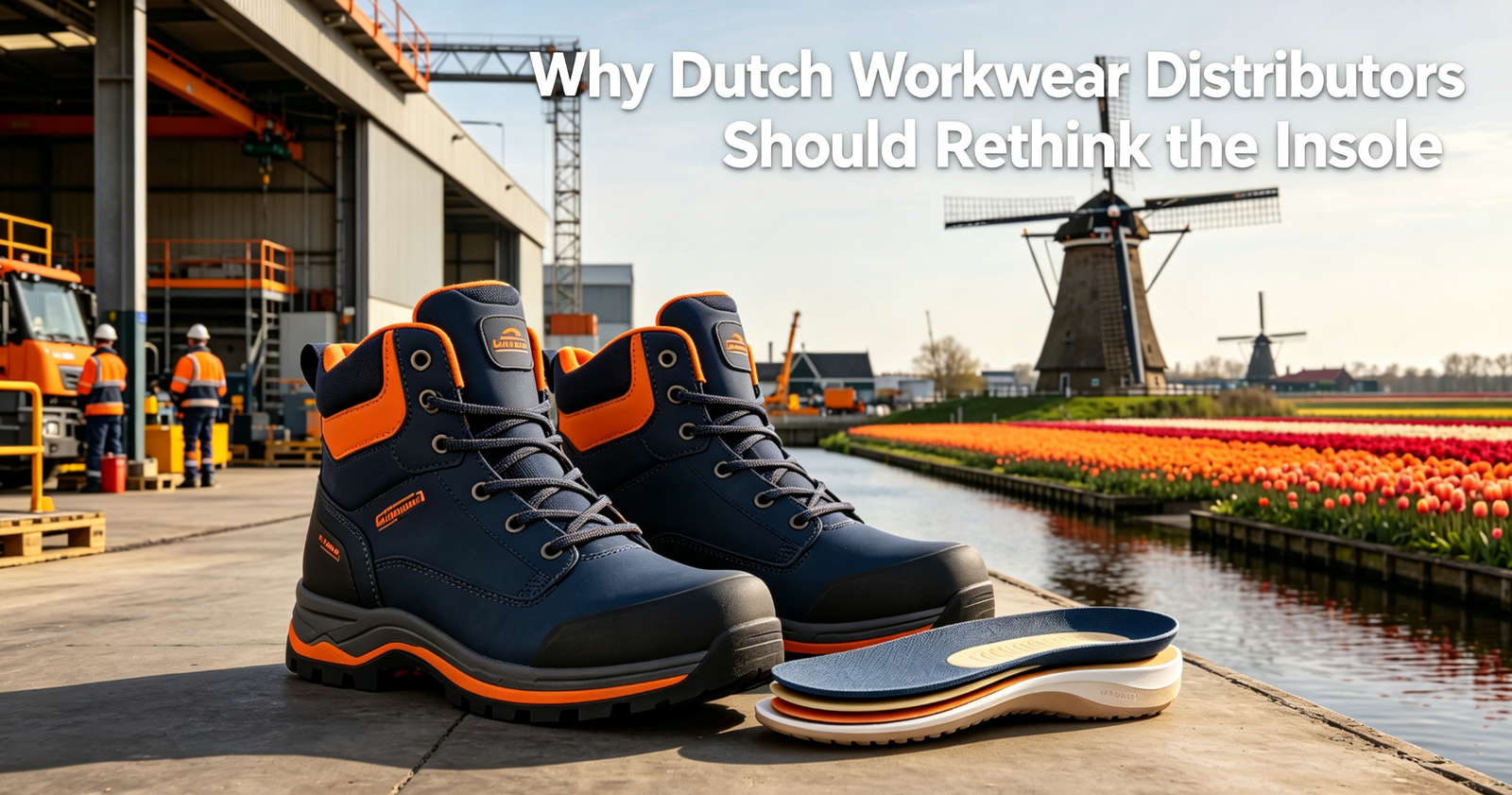
A safety shoe is designed to protect the worker.
But protection alone does not determine whether the footwear succeeds commercially.
The wearer may also care about:
- Comfort during long shifts
- Weight
- Fit
- Breathability
- Cushioning
- Stability
- Moisture management
- Durability
For the distributor, additional concerns appear:
- Purchase cost
- Replacement frequency
- Product consistency
- MOQ
- Private-label capability
- Delivery reliability
- Customization
- Compliance requirements
This creates two different perspectives.
The worker asks:
“Will I be comfortable wearing this all day?”
The distributor asks:
“Can I sell a reliable product that meets those expectations at a commercially viable cost?”
A good OEM development process needs to address both.

What the Dutch Market Tells Us About Workwear
Statistics Netherlands reported that in 2024, 33.6% of employees experienced physical strain at work. The most frequently reported form was prolonged sitting, followed by repetitive movements and physically demanding work.
This is important because “work footwear” is not one uniform category.
A warehouse employee may walk continuously.
A factory employee may alternate between standing and walking.
A construction worker may encounter uneven ground.
A retail employee may stand for long periods.
A healthcare worker may walk on hard indoor floors.
The same insole specification should not automatically be applied to all of them.
The Distributor’s Opportunity: Segment the Insole by Job
Instead of selling:
One Work Insole
a Dutch distributor can develop:
Warehouse Insole
Focus:
- Walking comfort
- Cushioning
- Lightweight construction
- Moisture management
Factory Insole
Focus:
- Long-hour standing
- Stability
- Pressure distribution
- Durability
Construction Insole
Focus:
- Stability
- Cushioning
- Durability
- Heel containment
Retail / Service Insole
Focus:
- Long-duration comfort
- Lightweight construction
- Breathability
Premium Safety Insole
Focus:
- Multi-material construction
- Advanced geometry
- Premium top cover
- Higher perceived value
This approach creates a stronger product portfolio.
Why “Soft” Is Not a Sufficient Specification
A common request from buyers is:
“We want a soft work insole.”
But softness alone does not define performance.
A very soft material may provide excellent initial comfort.
However, the product still needs to work with:
- The shoe
- The worker
- The activity
- The duration of use
- The required stability
Research into prolonged-standing footwear has shown that material hardness affects pressure and comfort differently across foot regions. One workplace study tested EVA insoles with different hardness levels and found that preferences differed among participants and changed after prolonged wear.
The practical implication is simple:
Do not buy softness. Buy the right specification.
Why Long-Shift Testing Matters
A workwear insole can feel excellent for five minutes.
That does not guarantee it will feel the same after a full shift.
In the workplace insole study, 65% of participants changed their preferred insole after wearing the products for a full workday compared with their initial immediate assessment.
For Dutch distributors, this is a strong argument for more realistic sample testing.
Instead of asking only:
“Do you like this sample?”
the development process should ask:
How does it perform after several hours?
Why Safety Shoes Create Additional Insole Constraints
Safety footwear can contain:
- Protective toe caps
- Puncture-resistant layers
- Reinforced uppers
- Structured heel counters
- Thick outsoles
These components affect internal space.
An insole that works in a running shoe may not work in a safety shoe.
The distributor therefore needs to consider:
Internal volume
Toe-box clearance
Heel position
Instep height
Existing footbed
Midsole geometry
This is why an OEM manufacturer should ideally develop the insole with the actual footwear.
EVA for Dutch Safety Footwear
EVA is a practical option for many safety footwear applications.
Potential advantages include:
- Lightweight construction
- Cushioning
- Multiple hardness options
- Flexible design
- Cost efficiency
- Easy customization
This makes EVA suitable for:
- Entry-level work insoles
- Warehouse footwear
- General safety shoes
- High-volume private-label programs
But EVA should not be specified only by name.
A serious RFQ should identify:
- Density
- Hardness
- Thickness
- Geometry
- Top cover
- Intended application
PU for Premium Workwear
PU can be considered when the distributor wants to position the product toward:
- Premium comfort
- Higher-value safety footwear
- Long-hour occupational use
- Private-label premium ranges
The development objective should not be:
“Use PU because PU is better.”
Instead:
Does PU provide the characteristics required for this particular footwear and price position?
That distinction helps prevent unnecessary material costs.
TPE for Functional Structures
TPE provides another option for buyers interested in more specialized constructions.
It can be used for:
- Support components
- Elastic structures
- Reinforcement
- Functional zones
- Hybrid insoles
A hybrid design could use:
EVA
for lightweight cushioning
TPE
for structural support
Textile
for surface comfort
This can create a differentiated product without making the entire insole rigid or excessively heavy.

Why Breathability Matters in Dutch Workwear
Workwear footwear may be worn for many hours.
A worker can therefore create a warm and humid microenvironment inside the shoe.
For distributors, this makes the top cover more than a visual choice.
Potential considerations include:
- Moisture management
- Air permeability
- Surface friction
- Drying characteristics
- Durability
The right top cover depends on the application.
For indoor warehouse work, breathability may be especially important.
For outdoor work, durability and moisture resistance may receive greater emphasis.
For premium occupational footwear, a combination of both may be required.
Why the Dutch Climate Influences Product Development
The Netherlands has a relatively cool, wet climate compared with many footwear markets.
That does not mean every Dutch work shoe needs a waterproof insole.
But it does mean the product developer should consider:
- Wet working conditions
- Rain
- Humidity
- Moisture inside footwear
- Drying time
- Seasonal changes
A warehouse worker and a construction worker may therefore require different material combinations even if both are buying “safety shoes.”
The Importance of Fit in Safety Insoles
A safety insole cannot compensate for an incorrectly sized shoe.
The insole should fit within the footwear without:
- Excessive compression
- Lateral movement
- Heel instability
- Toe-box interference
- Excessive instep pressure
This is especially important when replacing the original footbed.
A new insole can alter the internal geometry.
For this reason, the sample should ideally be tested in the actual safety shoe.
Why Dutch Distributors Should Avoid Over-Engineering
There is another side to customization.
More technology does not automatically mean more sales.
Suppose a distributor sells a mid-priced safety shoe.
Adding:
- Multiple materials
- Complex structures
- Expensive fabrics
- Custom molds
may increase the product cost significantly.
If the market does not value these features, the distributor may simply lose margin.
The better strategy is:
Start with the customer’s actual pain point.
If the main problem is:
Weight
→ optimize weight.
If the problem is:
Long-hour standing
→ focus on cushioning and support.
If the problem is:
Moisture
→ focus on the top cover and internal moisture management.
If the problem is:
Price
→ optimize material and manufacturing structure.
Customization should solve a commercial problem, not create a technical showcase.
How S-King Can Translate a Dutch Buyer’s Requirements
Imagine a Dutch distributor says:
“Our warehouse customers complain that the safety shoes become uncomfortable after long shifts.”
The S-King R&D process can break this into:
Application
Warehouse
↓
Activity
Long periods of walking + standing
↓
Footwear
Safety shoe
↓
Main issue
Long-duration comfort
↓
Material
EVA / PU / hybrid
↓
Structure
Heel cushioning + controlled arch support
↓
Top Cover
Comfort + moisture management
↓
Prototype
Test in actual safety shoe
↓
Evaluation
Fit + comfort + durability
↓
Revision
Adjust hardness, thickness and geometry
↓
Production
Mass manufacturing + QC
This is the value of an R&D-driven OEM supplier.
Why Product Development Should Start With the Shoe
The most useful sample for a factory is not always a drawing.
It can be the actual shoe.
Why?
Because the supplier can directly evaluate:
- Available internal volume
- Existing footbed
- Heel geometry
- Toe clearance
- Midsole construction
- Footwear flexibility
The result can be more accurate than designing an insole in isolation.
For Dutch distributors developing private-label safety footwear, sending the actual shoe can significantly improve the communication between buyer and manufacturer.
A Practical OEM Workflow for Dutch Distributors
Step 1 — Define the Market
Who will wear the footwear?
Step 2 — Define the Job
Warehouse? Factory? Construction? Retail?
Step 3 — Define the Pain Point
Comfort? Weight? Moisture? Durability?
Step 4 — Provide the Footwear
Actual shoe or technical specifications.
Step 5 — Select Material
EVA / PU / TPE / hybrid.
Step 6 — Develop Structure
Thickness + heel + arch + forefoot.
Step 7 — Prototype
Produce the first sample.
Step 8 — Test
Evaluate the product inside the actual footwear.
Step 9 — Revise
Modify according to feedback.
Step 10 — Production
Lock the specification and begin mass manufacturing.
What a Dutch Distributor Should Include in an RFQ
A better RFQ might look like this:
Application
Warehouse safety shoe
Target Market
Netherlands / EU
User
Workers wearing footwear for extended shifts
Main Requirement
Long-duration comfort
Material
Open to recommendation
Target Thickness
To be determined with supplier
Target Price
Commercial mid-range
Quantity
Initial order + annual forecast
Customization
Logo + private label
Testing Requirement
Actual footwear testing
Delivery
Required warehouse date
This gives the supplier enough information to propose a product rather than simply quote a catalog SKU.
Why R&D Capability Can Reduce Procurement Risk

For distributors, choosing a supplier based only on factory price can create hidden costs.
If the first sample is wrong:
→ another sample is required.
If the structure is wrong:
→ tooling may need modification.
If the insole does not fit:
→ product launch may be delayed.
If production consistency is poor:
→ customer complaints increase.
If the supplier cannot modify the design:
→ the distributor may need to start development again elsewhere.
An R&D-capable manufacturer can help reduce these risks by handling more of the development process internally.
S-King’s Value to Dutch Workwear Buyers
The benefit of working with S-King is not simply access to several insole materials.
The larger value is the ability to connect:
Customer Requirement
→ R&D
→ Material Selection
→ Structural Design
→ Sampling
→ Modification
→ Mass Production
→ QC
This gives distributors a single development path instead of coordinating multiple suppliers for materials, tooling, samples and production.
For buyers developing private-label work insoles, this can simplify communication and reduce unnecessary development steps.
A Better Product Strategy for Dutch Distributors
Instead of creating one universal product, distributors can build a structured range.
Basic
EVA
Lightweight
Cost-controlled
High-volume
Comfort
EVA / PU
Improved cushioning
Long-shift applications
Support
EVA + TPE
Functional structure
Premium positioning
Premium
PU / hybrid
Advanced top cover
Higher-value footwear
This allows the distributor to cover multiple customer groups without forcing one specification into every application.
Conclusion
The Dutch workwear market should not be approached with a single “best work insole.”
The worker, footwear, activity and environment all influence what the insole needs to accomplish.
Statistics Netherlands reported that 33.6% of employees experienced physical strain at work in 2024, highlighting the scale of occupational physical demands across Dutch workplaces.
Research on workplace insoles also shows why a simple “softer is better” strategy is insufficient: hardness preferences can vary between users and can change after prolonged wear.
For Dutch distributors, the better sourcing strategy is:
Job Application
→ Footwear
→ User Requirements
→ Material
→ Hardness
→ Geometry
→ Prototype
→ Real-Use Evaluation
→ Revision
→ Mass Production
S-King can support this process through EVA, PU, TPE and hybrid insole development, customized structures, OEM/ODM production, sampling and QC.
The commercial objective is not to make the most technically complicated work insole.
It is to develop a product that solves a specific occupational footwear problem at a price the Dutch market can actually support.


