There is no standard number of sampling rounds, and any supplier who quotes one without asking about your program is quoting a number, not an answer. What actually determines the count is how many open questions your program carries: every variable that has not been proven yet needs a round to prove it, plus one pre-production sample to lock the result.
The most common mistake at this stage is measuring progress in elapsed weeks instead of settled questions. A buyer waits for the next sample to arrive, the sample arrives, it sits in an inbox for two weeks, feedback goes back as a forwarded email with three unrelated comments — and the program loses a month without anyone making a technical decision. Cadence is a buyer-side discipline as much as a supplier-side one.

Rounds Are Counted in Questions, Not in Weeks
A sampling round exists to answer a question that can only be answered by holding an object: does the geometry fit, does this foam behave under load, does this laminate survive flexing. Questions that can be answered on a screen — outline, thickness map, arch profile — should never occupy a physical round. That filter alone removes rounds from most programs.
So the working rule is simple: plan one round for each unproven variable, plus one final round for the pre-production sample. A private label program on an existing mold starts with almost everything proven; a new geometry on a proven construction carries one unproven variable; a new geometry with a new material carries two, and they should not be tested in the same round. What each round actually contains is covered in what happens during insole sampling.
The Three Program Shapes
The lengths below are relative, not absolute — the point is which variables are still open when sampling starts, because that is what you are paying for in rounds.
| Program shape | Rounds to plan for | Why | Where the buyer can compress it |
|---|---|---|---|
| Private label on an existing mold | Shortest — confirmation sample, then pre-production | Geometry and material are already proven; only branding and your spec are new | Lock the spec before the confirmation sample, not after |
| New geometry on a proven construction | Typical — fit round, revision slot, pre-production | Geometry is new, so fit has to be proven on an object | Bring the thickness map and the shoe’s internal volume to round one |
| New geometry plus unproven material or construction | Longest — material or construction rounds first, then geometry, then pre-production | Two unproven variables in one round produce results you cannot attribute to either | Run material candidates side by side inside a single round |
Two things follow from this table. First, the extra rounds in the third shape are not waste — they are the cheapest place in the entire program to be wrong. Second, a program that keeps needing rounds is usually not a hard program; it is a program with an unresolved decision upstream. The five decisions that cause most of these loops are listed in the questions to settle before mold development starts.
What Actually Makes a Round Long
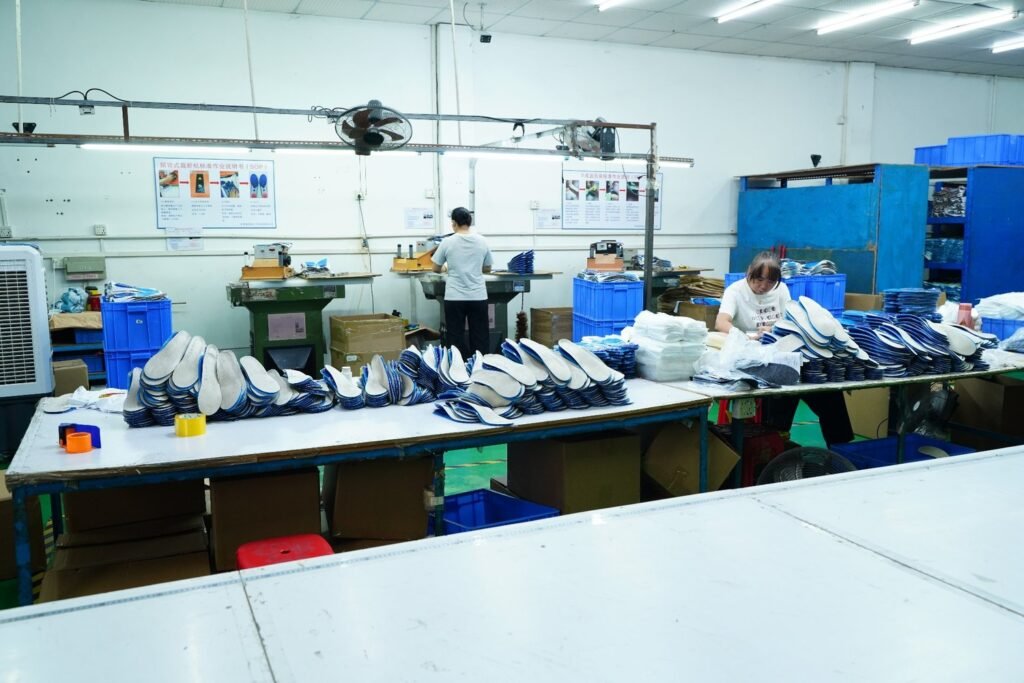
Every round is four segments stacked end to end: the sample build at the factory, transit if the sample is shipped to you, your own review, and the revision execution if the round produces changes. The supplier controls the first and last; the middle two are where rounds quietly double.
The build segment is the one buyers underestimate least and control least — it depends on the construction and how much of the round is hand work. The review segment is the one buyers underestimate most and control entirely. It has no fixed duration because it depends on when your team actually replies, and in our experience it is the single largest variable in sampling schedules.
Practical compression, all of it on your side: name one decision maker before the first sample ships, agree an internal review deadline at the same time you approve the sampling plan, and return feedback as one consolidated message — a numbered list, photographs with the area circled, or a marked-up drawing. Three separate emails sent over two days cost a week of the program’s own schedule.
How to Need Fewer Rounds
Batch the changes. Six edits in one round cost far less than six rounds with one edit each, because every round carries fixed overhead — setup, build, shipping, review. Bundling is the single biggest lever a buyer has on cadence.
Test independent variables side by side. Two material candidates can usually be built in the same round and compared directly. Sequential testing of independent variables adds rounds without adding information.
Keep dependent variables in order. The reverse also holds: if thickness changes, the fit results from the earlier round no longer describe the current design. Testing dependent variables together produces a round whose results you cannot use — the most expensive kind of round there is.
Do not reopen a locked decision. Once geometry is approved, changing it later forces a re-check of everything downstream of it — fit, tooling, shrinkage. Reopening is sometimes necessary, but it should be a deliberate trade, not a habit.
Manufacturer Insight
The pattern we see most in programs that run long is not a factory problem. The sample is built, shipped, and then waits in an inbox. Meanwhile the schedule is being measured against a calendar the buyer is looking at, and the factory is measured against a decision nobody has made yet. Programs that finish quickly are not the ones that skipped rounds — they are the ones where one person owned the decision and replied on time.
The second pattern is the opposite one: rounds that continue past the point of value. The last small increment of polish on a sample usually costs a full round and rarely changes the field outcome, while a locked spec and a pre-production sample are what actually protect the order. At some point the useful move is to approve, seal the golden sample, and let production confirm what sampling has already proved.
Frequently Asked Questions
How many rounds of insole sampling is normal?
There is no fixed number, because rounds track open questions rather than industry custom. Two is the practical minimum — a confirmation round and a pre-production sample — when the geometry and material are already proven. Three is common when one variable is new. When a program needs more than that, the cause is usually an upstream decision left open rather than a difficult product.
How long does each sampling round take?
Each round is build, transit, your review, and revision. The factory controls the first and last segments; the middle two are usually the buyer’s to compress. Ask for a milestone plan rather than a duration, and set your own review deadline at the same time. A quoted duration without the scope attached is not comparable between suppliers.
Can sampling rounds be run in parallel?
For independent variables, yes — two material candidates or two sizes can often be built in the same round and compared directly. For dependent ones, no: change the thickness and the earlier fit results stop describing the design. The question to ask is whether the two results would still be readable if both variables moved at once.
What delays approval most often?
Review latency on the buyer’s side, usually because no single person owns the decision or because feedback arrives in fragments. The second most common cause is reopening a decision that had already been locked. Both are process issues rather than manufacturing ones, which is why they are also the easiest to fix.
The Short Version
- Plan one round per unproven variable plus a pre-production sample — the count comes from your open questions, not from an industry average.
- Every round is build, transit, review and revision; only two of those four segments belong to the factory, so the biggest lever on cadence is on your side.
- Batch changes, test independent variables side by side, and stop polishing once production is the better place to confirm the design.
The rounds themselves are described in the insole sampling process, from sample line to approval, and the decisions that determine how many rounds you need are covered in how insole mold development works. Our production line page shows where the pre-production sample is run, and the OEM/ODM page shows how sampling fits the wider development service. If you want a sampling plan costed for a specific program, send us the construction and the target market and we will map the rounds it needs.